
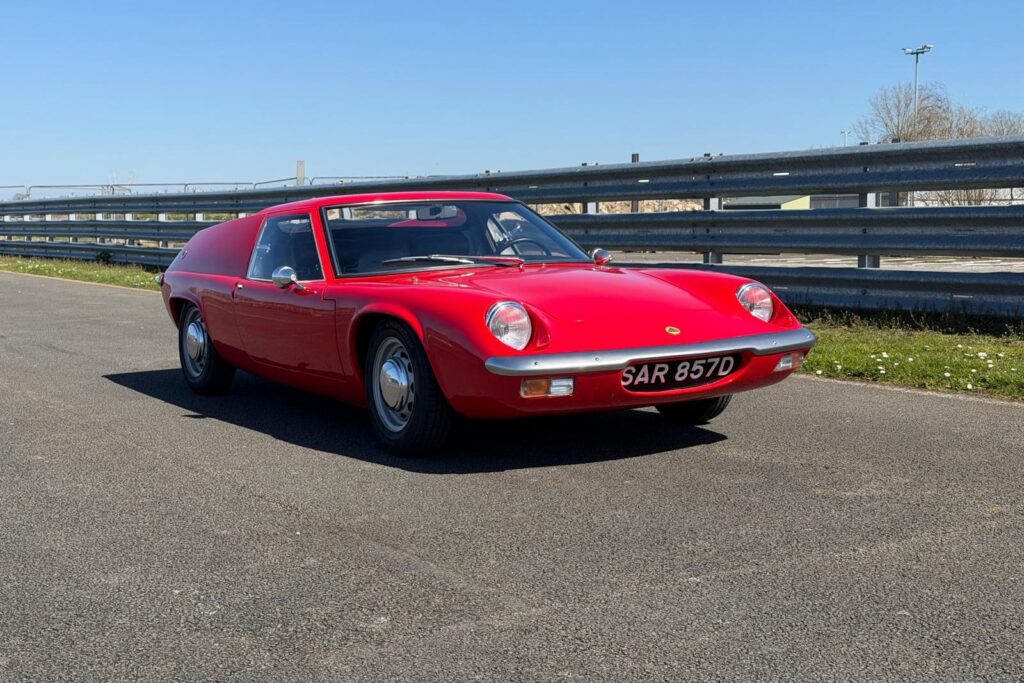
1966 Lotus Europa Series 1
Lotus type46The first mid-engined Lotus road car - and one of the earliest built
When the Europa was announced in 1966 it did something no affordable road car had yet managed: it put the engine behind the driver, where Grand Prix designers had already proved it belonged. Ron Hickman's design wrapped a glassfibre body around a folded-steel backbone chassis, with a Renault 16 engine and transaxle turned back to front and carried amidships.
It was uncompromising with it. The body was bonded to the chassis, the side windows did not open, and the seats did not move – the driver moved the pedals instead. The result weighed around 612kg, less than most of today's small hatchbacks.
This is one of the earliest cars built. It was photographed for Motor's launch coverage, published in the issue for the week ending 24 December 1966, and appeared widely in the press that first winter. It later spent some years as a racing car before being restored to original specification.
Motor, week ending 24 December 1966. Charles Bulmer's launch article, headed “Europa – An Anglo-French project by Lotus with Renault engine”, was illustrated with this car. Motor noted that the model was known variously as the Lotus Europa, the Lotus-Renault GT or simply the Lotus 46. The photographs were by Tom Northey.
A French car first. Readers were told the Europa would not be sold in Britain for at least a year, if at all. The first 500 cars were going to France, through Lotus importers rather than Renault dealers, with Belgium, Holland and other European markets to follow – and all of them left-hand drive. In France it was expected to cost about what an MGB did here.
Renault's idea. The engine, gearbox and final drive came from the 1.5-litre Renault 16, supplied as a complete assembly by Régie Renault with the modifications needed to lift output to 78bhp and suit a different chassis. Motor understood the suggestion had originally come from Renault, but was careful to record that this was no commercial partnership: “Lotus are just ordinary customers.”
Eighteen months. Development was compressed into roughly a year and a half by a team Chapman drove personally, with standard production components used wherever they would serve. That is how the Europa reached a price bracket below the Elan, which it was never intended to replace.
Afterwards. Press cars are usually worked hard and quietly disposed of. This one went racing, and has since been brought back to the specification in which it was first photographed.
Why it matters
Sixty years on, the car that showed Britain what a mid-engined Lotus looked like is still here to be looked at.